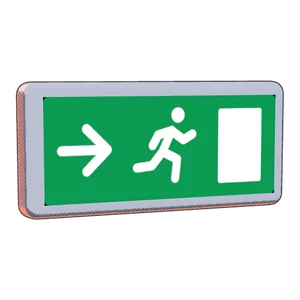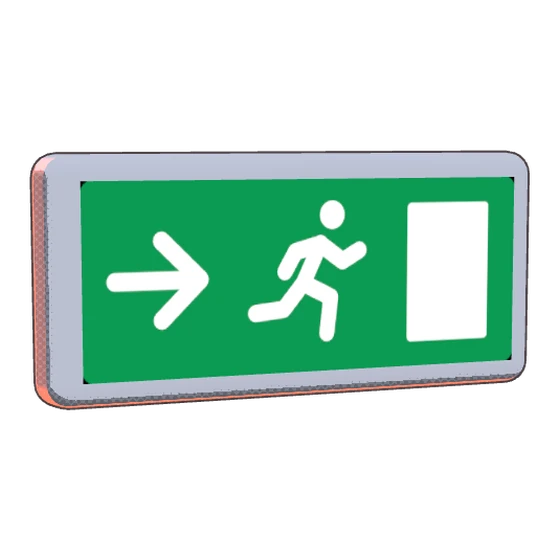
Exit signs and emergency lights are some of the least noticed things in a building. They sit on the ceiling or above a door, glowing quietly, and nobody thinks about them until the power goes out.
What they are for
When a building loses power, the normal lights go with it. In a fire, smoke can make things worse. People who know a building well can still lose their bearings in the dark, and visitors may not know the way out at all.
Exit signs show where the way out is. Emergency lights give enough light along the path to get there, so people can see stairs, corners and obstacles. Together they help everyone leave calmly and without injury.
How they keep working when the power fails
In normal use each fitting runs off mains power. It also has a backup battery, usually inside the fitting itself, and in some buildings in a central system. While the mains is on, the battery stays charged. When the mains fails, the fitting switches to the battery automatically and keeps the sign or light going.
Some fittings are lit all the time. Others stay off and only come on when the power drops. So an emergency light that is dark on a normal day is not necessarily faulty. An exit sign that is dark is a different matter, and is worth reporting.
Why they need periodic testing
Batteries wear out. One that has been sitting on charge for a long time can look fine and then fade quickly once it is asked to do the work. You can’t tell by looking at a lit sign whether the battery behind it is any good, because on a normal day the sign is running off the mains.
Testing is how that gets found out. In simple terms, a test takes away the mains supply and checks that the fitting keeps running on its battery for as long as it should. Fittings that fail are repaired or replaced, and the results are recorded.
How often testing is needed and what it involves is set out in the Australian Standards for routine servicing, and the detail depends on the system installed. The building owner or manager is usually the one who arranges it. If you are not sure what applies to your premises, ask them, or start with the NSW Government website for information on fire safety in buildings.
Signs of trouble
You don’t need to test anything yourself to spot a problem. Keep an eye out for:
- an exit sign that is dark, or lit only in part
- flickering or buzzing
- a cover that is cracked, missing, loose or badly discoloured
- a fitting hanging away from the ceiling or wall
- water stains or scorch marks around a fitting
- a sign hidden by shelving, stock, a banner or a new partition
- a sign that points the wrong way after a renovation or change of layout
- an indicator light on the fitting that has gone out or changed colour, if yours has one
The ones about visibility and direction are easy to miss. A sign can be working perfectly and still be no use if nobody can see it, or if it sends people towards a door that is now a storeroom.
What to do about it
Report the problem to whoever looks after the building, and note the date and which fitting it was. If you are the owner, pass it on to your fire or electrical contractor. These fittings are wired to mains power, so repairs are a job for a qualified person and not something to open up yourself.
After a blackout, take a quick walk around once the power is back. If any fitting stayed dark while the power was off, report it.
If the lights go out and there is any sign of fire or smoke, leave by the nearest exit. In an emergency, call Triple Zero (000).
If you have noticed a problem with the exit signs or emergency lights at your premises, V&H Fire Group can help between the Central Coast and Newcastle. Call Byron on 0483 371 134 to talk it through.
This article is general information, not advice for your building. For what applies to your premises, talk to us on site.